Alpine Loop from Silverton
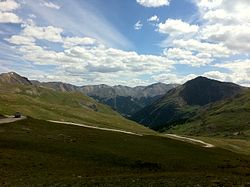
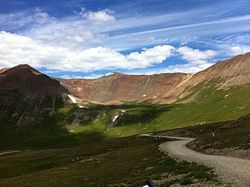
The Alpine Loop Backcountry Byway is a rugged 4x4 road that winds through the spectacular scenery of the San Juan Mountains, connecting Lake City, Silverton, and Ouray. The Alpine Loop byway traverses passes up to 12,800 feet while showcasing old mines, ghost towns, natural wonders, beautiful wildflowers, and abundant wildlife. Alpine Loop is an avenue for exploring nature and history amidst thrilling views and stunning geography. Tackling the loop in its entirety is easily an all-day experience event. However, the main loop is only part of the experience; miles of designated side routes allow visitors to either take a short tour or extend their trip to multiple days.
The Alpine Loop is truly a backcountry experience. Make sure someone knows your travel plans and do your homework before you start your trip. Make sure you have plenty of water, food and fuel to make it to your destination. Electronics and wireless devises DO NOT work in most places on the Alpine Loop. It is recommended that you download or print hard copy maps prior to your trip. – BLM Overview
The depicted route originates from Silverton, but note that either Ouray or Lake City can serve as a base.
 OHV Riding (>50”)
 ATV Riding
 Motorcycle Riding
- Loop
 Alpine
- History
- Scenic
 Geology
- Wildflowers
 Wildlife
 Waterfalls


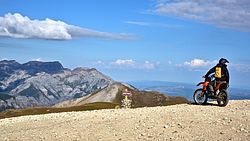

A town rich in mining history, as its name suggests, Silverton now serves as a base for recreation of every kind. OHVs are allowed on a limited set of routes in town, so be sure to check out the latest information on this Silverton page.
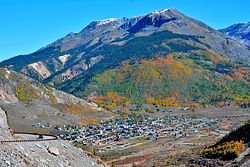
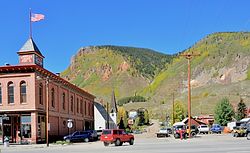
The Mayflower Mill was built in 1929 by the Shenandoah Dives Mining Company, to process ore from the Mayflower Mine as well as other mines in the area. Except for a few years in the 1950s, the Mayflower Mill operated nearly continuously for over 60 years. It processed over 10 million tons of ore that yielded over 1.5 million ounces of gold and 30 million ounces of silver before it closed in 1991.
During the summer, this well-preserved mill is open for self-guided tours and has a gift shop. Owned and staffed by the San Juan County Historical Society, it is the only Colorado mill of its kind in functional condition today. Read more on its official site.
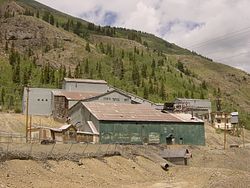
Howardsville was established in 1874 by the Bullion City Company and became the base for several mines that extended into the Cunningham Gulch. Although never platted, Howardsville became the first county seat for San Juan County. Howardsville was also the site of the first Sunnyside Mill, which at the time was the largest mill in the United States.
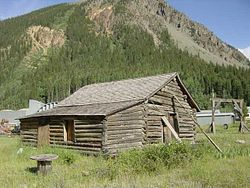

While nothing remains today, this is the site of a slightly younger sibling to the neighboring mining towns. Its name originated in the fact that it is midway between then-established Eureka and Howardsville.
The community of Eureka was laid out in 1874 but prospecting in Eureka Gulch dates back to the 1860s. The town’s growth was linked to the development of the prosperous Sunnyside Mine, whose foundations still remain today. The Silverton Northern Railroad was extended from Arrastra Gulch to Eureka by Otto Mears in 1896 to handle ore from the Sunnyside Mill. The Sunnyside Mine began to produce ore in 1873 and closed in 1938, after changing hands many times.The Sunnyside Mine reopened in 1960 after the 6,233-foot American Tunnel was driven through the mountain from Gladstone. In 1978, miners in the Sunnyside Mine bored through the bottom of Lake Emma. Their actions drained the lake and flooded the mine but fortunately no one was injured in this accident.
This is also the location of another OHV staging area and restroom.
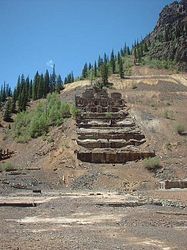
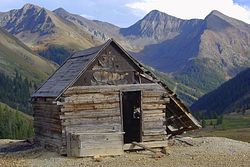
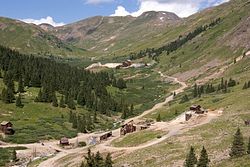
Animas Forks was originally named Three Forks. It was developed in 1873 at 11,200 feet in elevation. By 1876 there was a sizable hotel, a general store, saloon, post office, and thirty cabins. In 1904 the Gold Prince Mill was built and the Silverton Northern Railroad was extended from Eureka and terminated in Animas Forks. An aerial tram was also installed to transport ore from the Gold Prince Mine in Placer Gulch to the mill.The good times began to fade by the start of the 20th century as profits declined, leaving a ghost town by 1920. Numerous structures still remain with interpretive signage and restrooms, making this one of the route’s most popular stops.

Not depicted on this Featured Route, Ouray makes a great starting point for the loop as well. Note that OHVs are not allowed to drive within Ouray itself and must start the loop 4 miles southeast at the start of Engineer Pass Road (#878). Read more about OHVs in Ouray here.


Just shy of the pass, Odom Point is on a short spur and offers some of the best 360 views in the area.
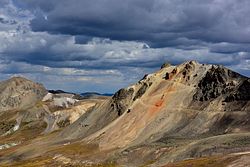
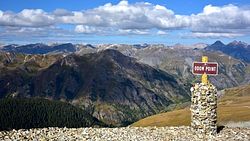
Engineer Pass, at 12,800 feet, is situated on the rim of two extinct volcanic calderas. The pass offers spectacular views of the surrounding peaks, with Uncompahgre Peak (14,309’) to the east and Mt. Sneffels (14,150’) to the west. Otto Mears, the “pathfinder of the San Juans,” built the Lake City-Silverton Toll Road over Engineer Pass. The first stagecoach (wagon) crossed this pass in 1877.


Rose’s Cabin was named for Corydon Rose, who built a roadhouse at this location in 1875. The cabin had 22 small rooms on the second floor and provided meals and overnight accommodation to travelers. The cabin had a restaurant and bar and there was a 60-stall stable nearby.
A public restroom and rest area can be found just after the ruins, which are on private land.

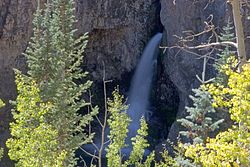
Originally called Galena City, Capitol City was renamed in 1877. The community had a number of stores and hotels, as well as a post office, charcoal kilns, and an ore smelter. Capitol City boasted a population of about 400 people, including George Lee, an influential investor and businessman, who built a brickhouse that became known as Lee’s Mansion.
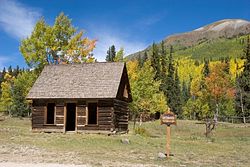
Rose Lime Kiln was built in 1881 by George S. Lee, a local businessman and investor. An ash-free lime was produced in this kiln and used as a cement additive. The kiln was named after Rose Lee, the daughter of George and Mary Jane Lee.
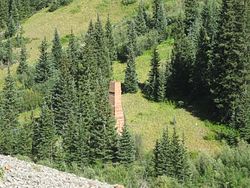
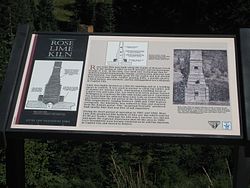
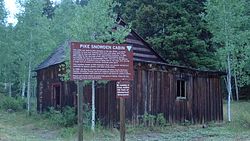
This cabin was built by Pike Snowden in the late 1870’s. A colorful character in local lore, Snowden lived here until about 1915 while exploring for lead and silver in the surrounding mountains. – Excerpt from BLM signage (tap photo or view cabin’s full page to read more)
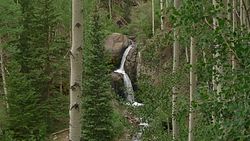

Ute-Ulay Mine was discovered in 1871, making it one of the earliest mines in the Galena Mining District. By 1880, the nearby town of Henson was platted. In the 1890s, power for the mine was supplied by the 118-foot-high Henson Creek Dam. In 1899, miners protesting poor living conditions at the Ute-Ulay mine called for a mine strike. In response, the governor brought in National Guard troops and the strike was quickly ended. Settlement agreements with the union required that Italians, who were heavily involved in the strike, leave Hinsdale County.
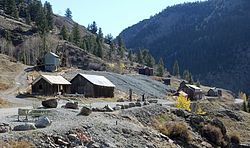
Lake City is also a wonderful base of operations for tackling this loop, in addition to Silverton and Ouray. OHVs are allowed in town as of June 2019, but this may change later in the year so be sure to check the latest (Lake City website here).
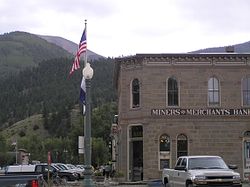

This has typically marked start of the southern loop for ATVs and vehicles requiring trailering from Lake City. There are no facilities here, but restrooms are found prior to reaching here at the Red Mountain Gulch OHV Staging Area.
The community of Sherman was established in 1875, adjacent to the Black Wonder Mine and Mill. In 1881, the Sherman House provided “Good accommodations for Travelers, Liquors, Wines, St. Louis Beer, and Cigars.” Planks from a suspension flume are visible from the shelf road above Sherman. The flume was used to transport water from the Lake Fork of the Gunnsion River to the Black Wonder Mill. The townsite itself is on private land.
Throughout its history, Burrows Park was home to a number of small communities, including Argentium, Burrows Park, and Tellurium (Whitecross). The population of the valley shifted from community to community, depending on which mines were active and the location of the Post Office.
There are several potential stops throughout the park, including a non-motorized trailhead with restroom.
American Basin is one of the most scenic alpine valleys in the San Juan Mountains. In midsummer, wildflower displays are wonderful. If you look closely, you may notice an alpine rock glacier on the north-facing slope at the end of the valley.
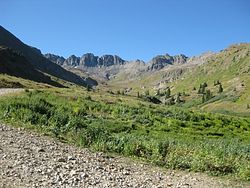
Cinnamon Pass at 12,620’ is one of the highest passes in the San Juan Mountains. Looking east you can see Handies Peak (14,048’), Redcloud Peak (14,034’), and Sunshine Peak (14,001’) – three of Colorado’s “fourteeners.”